Yousign — Product-Led Growth
Helped transition Yousign from a sales-led model to self-serve, enabling users to activate and upgrade on their own.
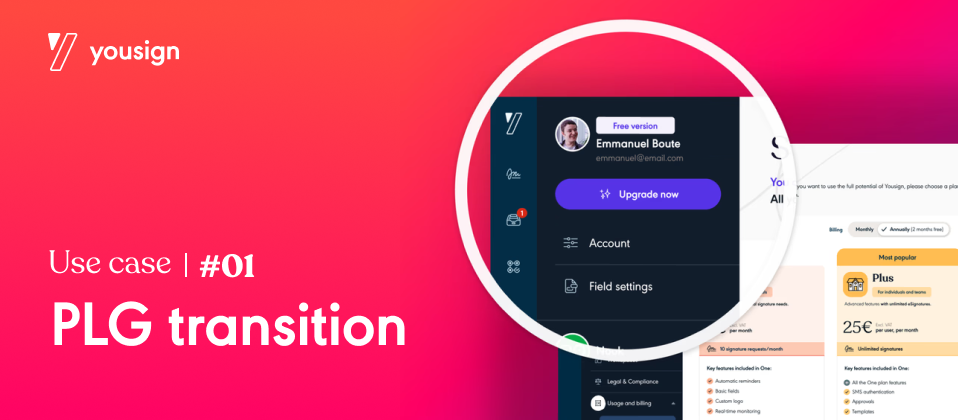
From sales-led to self-serve
After COVID, demand for electronic signatures surged among small businesses. Their needs were simple and budgets limited, making the traditional sales model too slow and expensive.
The opportunity: let users discover, try, and buy on their own.
The challenge wasn't just to design features, but to imagine a product experience that could sell itself.
The activation gap
The existing model was sales-assisted, effective for large accounts, but completely misaligned with the new wave of small, autonomous buyers.
- High acquisition costs for small customers
- Friction between signup and first value
- An experience optimized for sales, not self-serve
How we approached it
A small self-serve squad was formed composed of EM, PM, PMM, Designer (me), and 3 engineers. We operated as an impact team with one key result: grow revenue through the self-serve channel.
Discovery & activation mapping
Ran 12 user interviews and analysed 3 months of product analytics to map the critical activation milestones. Identified the precise moment users understood Yousign's value — and what blocked them from getting there.
Onboarding redesign
Rebuilt the new user experience from the ground up — reducing time-to-first-signature from 8 minutes to under 2 minutes. Introduced a progressive disclosure model that revealed complexity only when needed.
In-product upgrade moments
Designed contextual upgrade prompts that appeared at natural friction points — not interruptive pop-ups, but embedded signals that made the paid value tangible in context.
Test, measure, iterate
Set up an A/B testing cadence with the growth team. Ran 14 experiments over 6 months, learning rapidly about what messaging, timing, and friction levels actually moved the needle. Progress was communicated monthly to the Executive Committee and quarterly to the whole company.
Selected screens


Onboarding redesign & contextual upgrade moments

Activation milestone map & in-product guidance system
A new revenue channel, from zero
In 12 months, the self-serve channel went from zero to $1.5M ARR — no sales involved. The product became a standalone revenue source, exactly as intended.
With small accounts handled autonomously, sales teams shifted focus to higher-value deals: API integrations, enterprise contracts.
What I took away
PLG design is fundamentally about reducing the distance between a user's first intent and their first success. The biggest insight: the "aha moment" for Yousign wasn't sending a document — it was seeing a signed, completed document returned. Reorienting the entire activation flow around that moment changed everything.
After over a year on this transition, six things stuck with me:
Know your "why" deeply
A PLG transition touches every part of the business. Without a crystal-clear answer to why you're doing it — and the ability to articulate it to anyone in the company — the initiative loses steam fast.
Think about what sales does next
PLG isn't about removing the sales team — it's about redirecting them. Having a concrete plan for where their freed-up time goes (in our case, the API product) is essential for internal buy-in.
A long-term roadmap is a communication tool
Structuring work around sequential, quarterly milestones made it easier for the team to stay focused and for leadership to track progress without micromanaging.
Strong exec support unlocks autonomy
With genuine buy-in from the Executive Committee, a team of 7 can drive a company-wide strategic transition. Without it, you spend more time selling internally than building.
Revenue as a KR creates clarity
Tying the team's objective to self-serve revenue — not features shipped or designs approved — forced every decision to be grounded in what actually moved the business.
Communicate impact relentlessly
Monthly open sessions, quarterly reviews, and sharing concrete results broadly kept the whole organisation aligned and invested in the transition's success. Visibility builds momentum.
I also learned how to operate at the intersection of design and growth — running experiments, reading funnel data, and making decisions based on evidence rather than assumption. This project cemented my belief that senior designers need to be fluent in the metrics that matter.