Yousign — Product-Led Growth
Helped transition Yousign from a sales-led model to self-serve, enabling users to activate and upgrade on their own.
From sales-led to self-serve
After COVID, demand for electronic signatures surged among small businesses. Their needs were simple and budgets limited, making the traditional sales model too slow and expensive.
The opportunity: let users discover, try, and buy on their own.
The challenge wasn't just to design features, but to imagine a product experience that could sell itself.
The activation gap
The existing model was sales-assisted, effective for large accounts, but completely misaligned with the new wave of small, autonomous buyers.
How we approached it
A small self-serve squad was formed: EM, PM, PMM, Designer (me), and 4 engineers. We operated as an impact team with one key result: grow revenue through the self-serve channel.
The squad roadmap was structured around 4 sequential workstreams, each unlocking the next.
Activation — New sign-up funnel
Redesigned the onboarding experience to reduce time-to-value and help new users reach their first meaningful moment with the product as quickly as possible.
Conversion — Free-to-paid
Designed contextual upgrade moments that surfaced at the right friction points, making the value of paid plans tangible without disrupting the user flow.
Conversion — Pricing rework
Revisited the pricing structure to better reflect user expectations and reduce friction at the critical decision point between free and paid plans.
Retention — churn reduction
Improved mechanisms to reduce churn and strengthen retention, ensuring converted users continued to perceive value and had clear paths to upgrade.
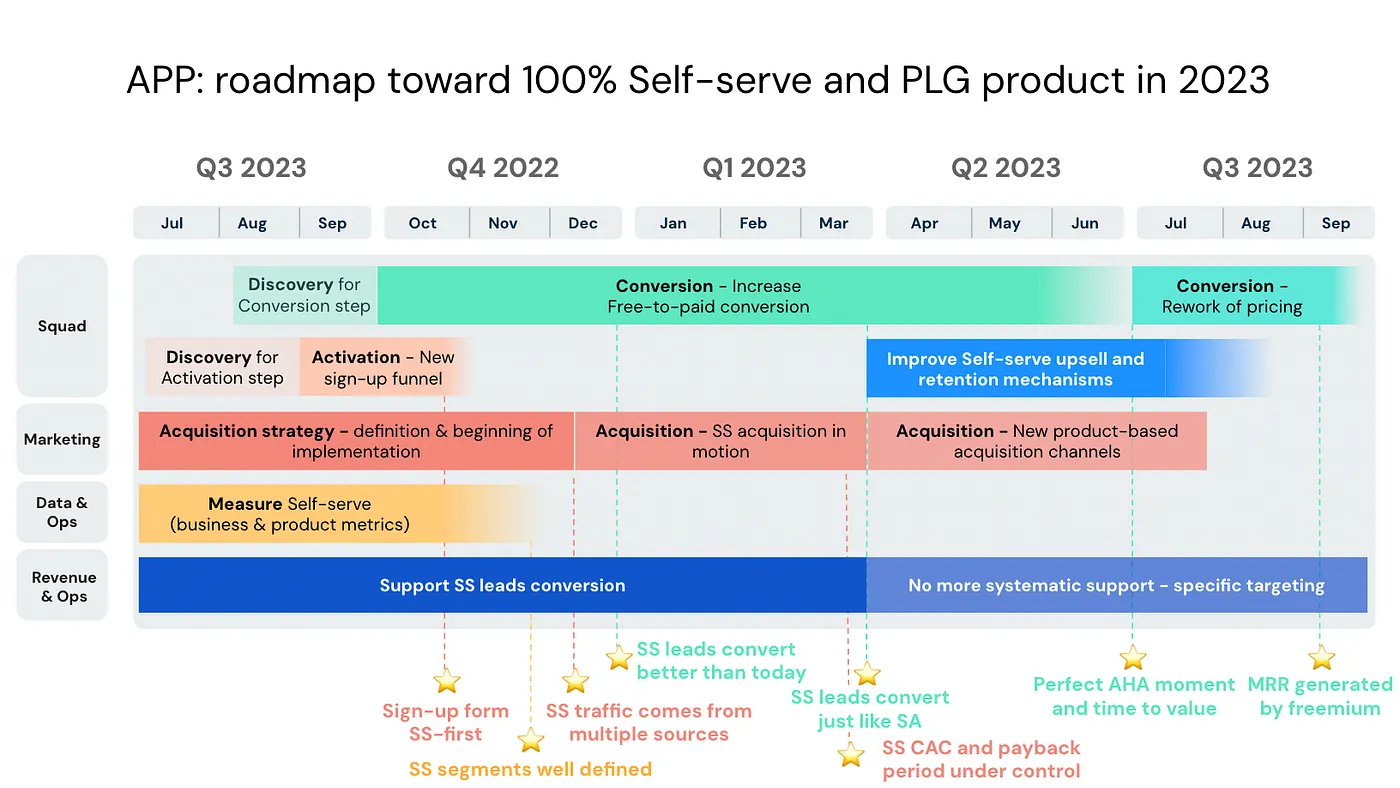
Squad roadmap — toward 100% self-serve and PLG product in 2023
New sign-up funnel
We ran extensive A/B tests to reduce signup friction across different user profiles, iterating on the flow to identify what removed the most barriers to activation. We also experimented with different signup flow formats to understand which structure converted best depending on the user context.
Internal prototype before AB testing for signup experience
Onboarding redesign
One of the key challenges was helping users quickly understand the product's value and reach their "aha moment."
Through user interviews, we discovered that this moment did not occur when users sent a document for signature, as we had initially assumed. Instead, it happened when they received confirmation that all parties had signed the document.
We introduced a demo document during the first-time experience, allowing users to quickly test Yousign's value proposition even if they didn't have a PDF ready to upload.
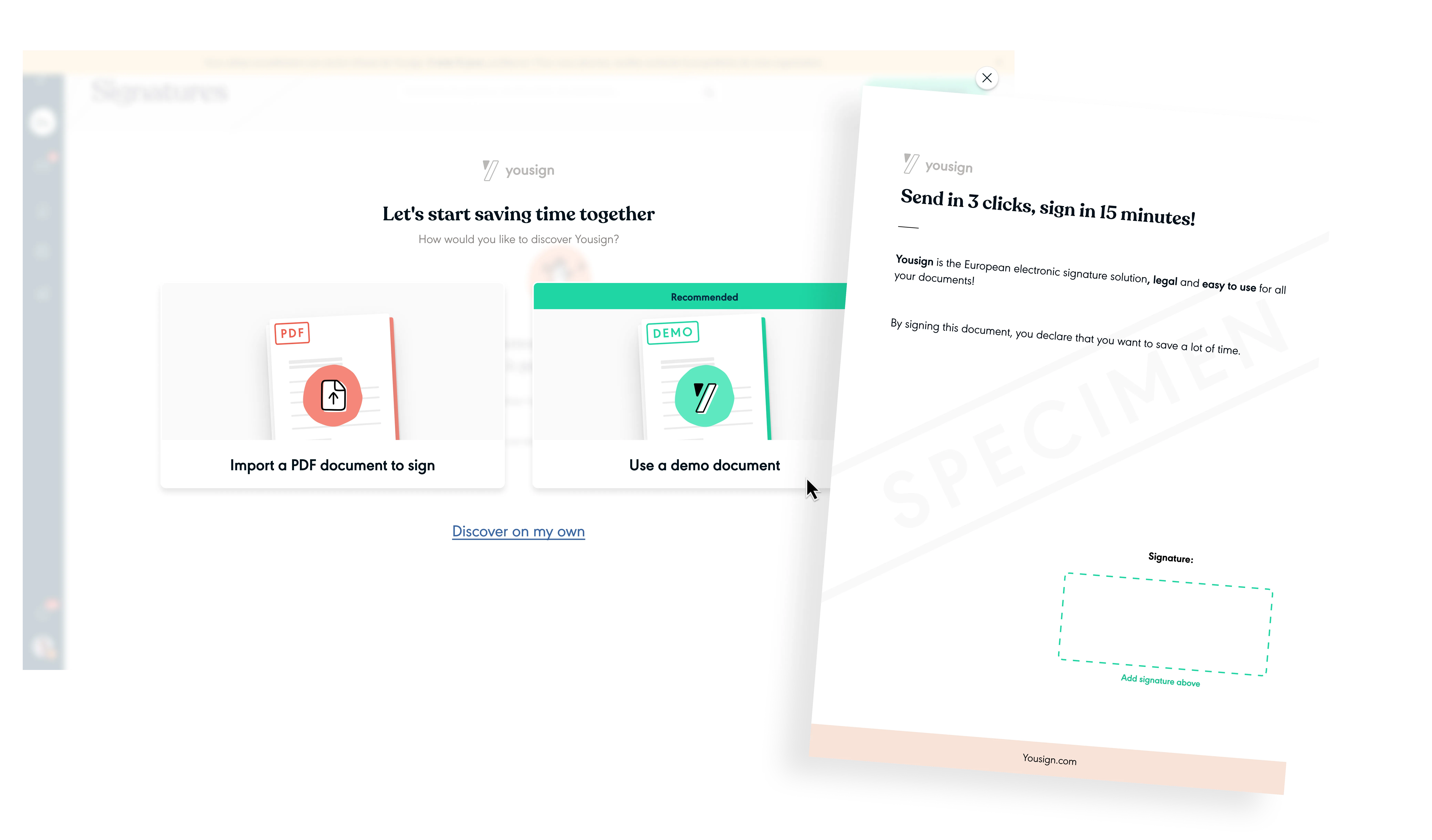
Demo document introduced in the onboarding flow, enabling users to experience Yousign's value instantly without uploading their own PDF.
Free-to-paid
Designed contextual upgrade prompts that appeared at natural friction points — not interruptive pop-ups, but embedded signals making the paid value tangible in context. Set up an A/B testing cadence and ran 14 experiments over 6 months.
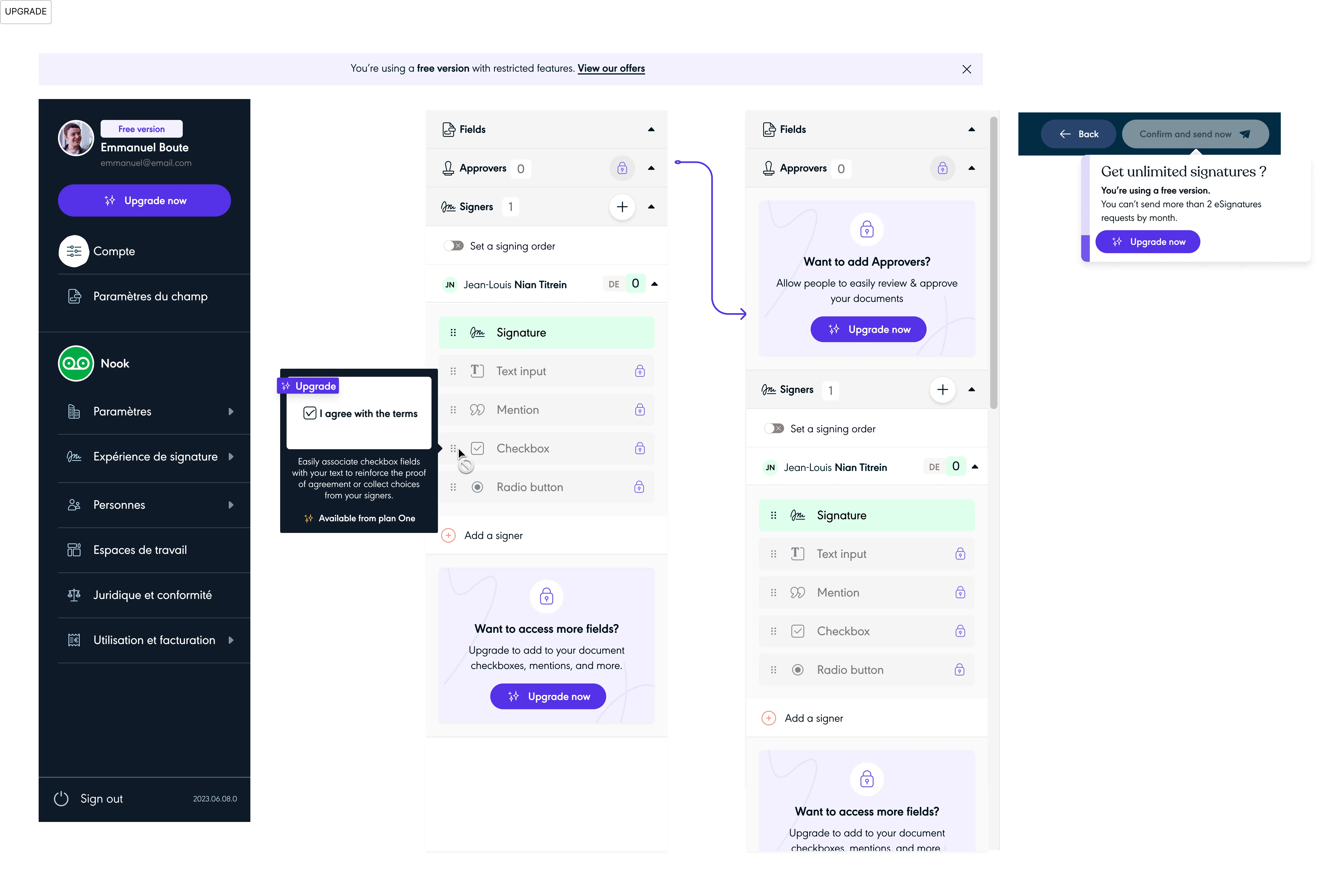
Upgrade mechanism — component system for contextual upgrade
Freemium mechanism - Figma prototype
Pricing rework
Revisited the pricing structure to better reflect the self-serve value proposition and reduce friction at the critical decision point between free and paid plans. This work was informed by user interviews, willingness-to-pay research, and a competitive benchmark, helping us better align pricing with user expectations and perceived value.
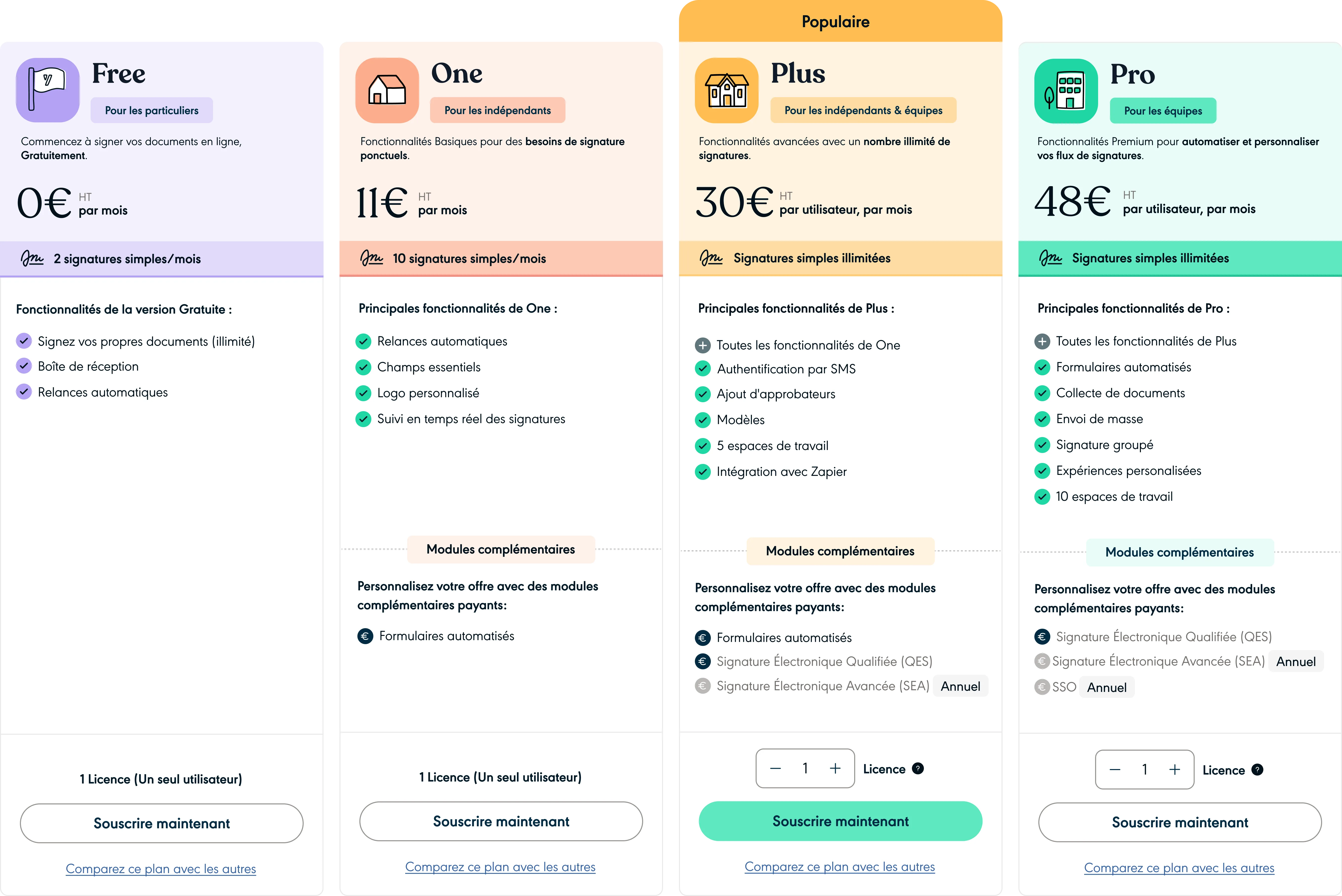
Pricing page rework — clearer plan differentiation for self-serve conversion
Reduce churn & improve self-serve retention
With the conversion baseline established, we shifted focus to improving upsell and retention mechanisms, ensuring users who converted stayed and grew their usage over time.
Churn reduction flow with contextual prompts at cancellation intent — Figma prototype
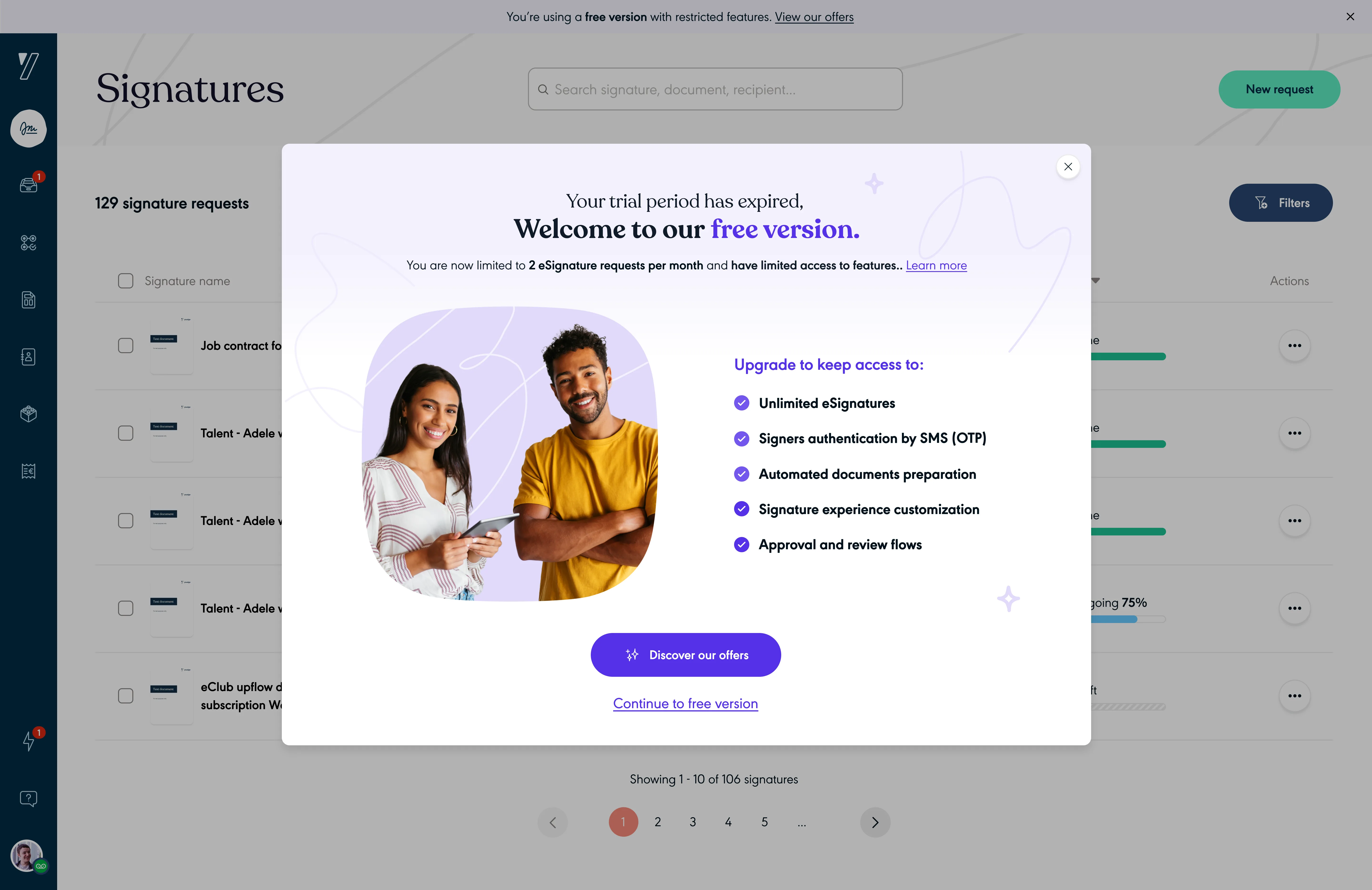
Dialog modal — trial to free plan transition
A new revenue channel, from zero
In 12 months, the self-serve channel went from zero to €1.5M ARR, no sales involved. The product became a standalone revenue source, exactly as intended.
With small accounts handled autonomously, sales teams shifted focus to higher-value deals: API integrations, enterprise contracts.
What I took away
PLG design is fundamentally about reducing the distance between a user's first intent and their first success. More than a product initiative, it represents a strategic company-wide transformation that requires rethinking processes, teams, and decision-making around delivering value directly to users.
Design around the real "aha moment"
Finding the exact moment users felt value changed everything. Once we knew it, we could design the whole experience around reaching it faster.
Think about what sales does next
PLG isn't about removing the sales team, it's about redirecting them. In our case, toward the API product.
Exec support gives the team room to move
With real buy-in from leadership, a small team can drive big changes. Without it, you spend more time convincing than building.